

by Przemysław Myszka
We've been reporting on the topic of cutting down the sea shipping industry's carbon intensity for a long time now and have done so from multiple angles - technological, financial, regulatory, and even political.
One of the latest analyses comes from the American Bureau of Shipping (ABS) which has investigated alternative fuel pathways toward reaching the International Maritime Organization's (IMO) greenhouse gas (GHG) emission reduction target: down to half of what was emitted in 2008, by 2050 (meaning to 460.5 million tonnes).
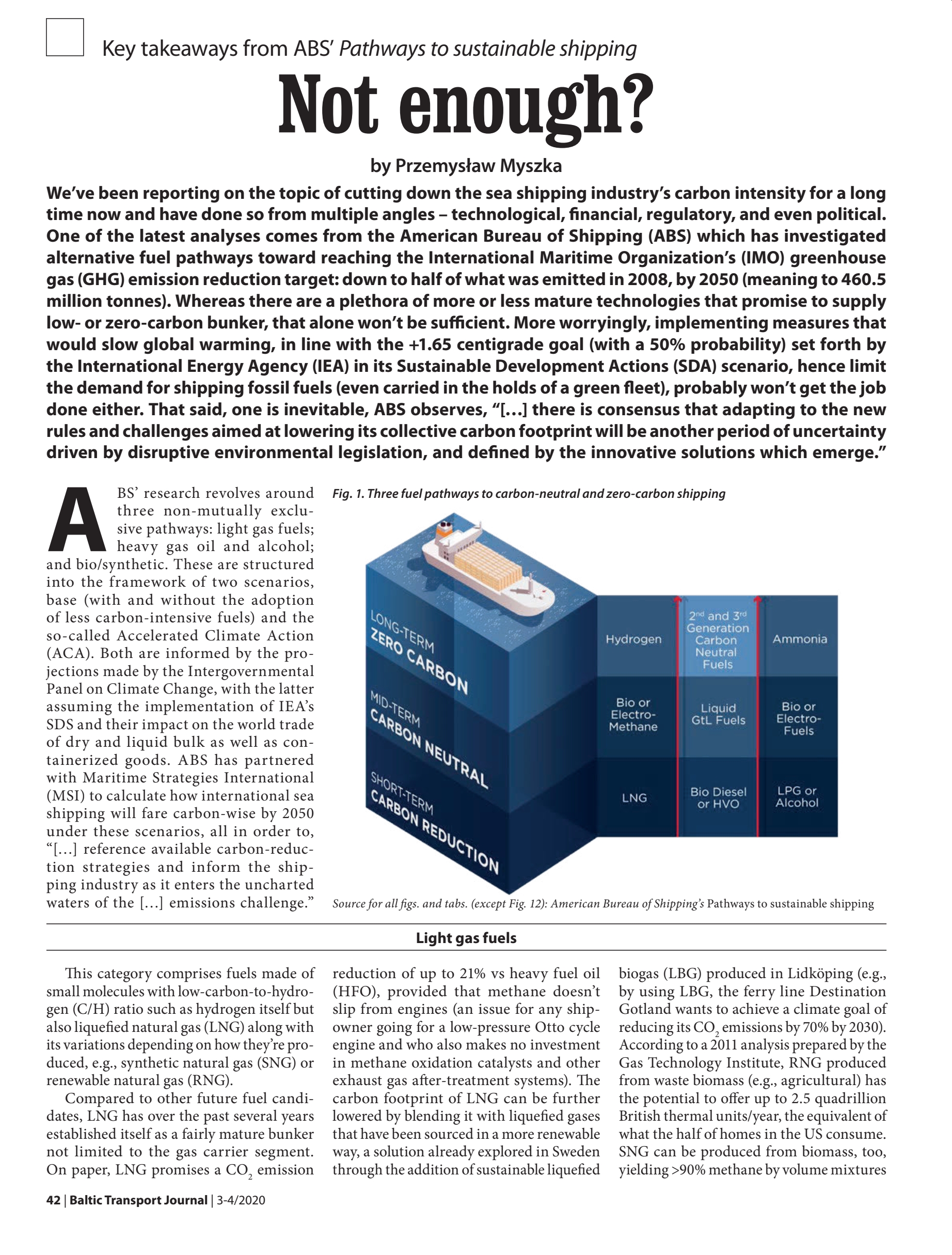
Whereas there are a plethora of more or less mature technologies that promise to supply low- or zero-carbon bunker, that alone won't be sufficient.
More worryingly, implementing measures that would slow global warming, in line with the +1.65 centigrade goal (with a 50% probability) set forth by the International Energy Agency (IEA) in its Sustainable Development Actions (SDA) scenario, hence limit the demand for shipping fossil fuels (even carried in the holds of a green fleet), probably won't get the job done either.
That said, one is inevitable, ABS observes, "[…] there is consensus that adapting to the new rules and challenges aimed at lowering its collective carbon footprint will be another period of uncertainty driven by disruptive environmental legislation, and defined by the innovative solutions which emerge."
Download PDF