

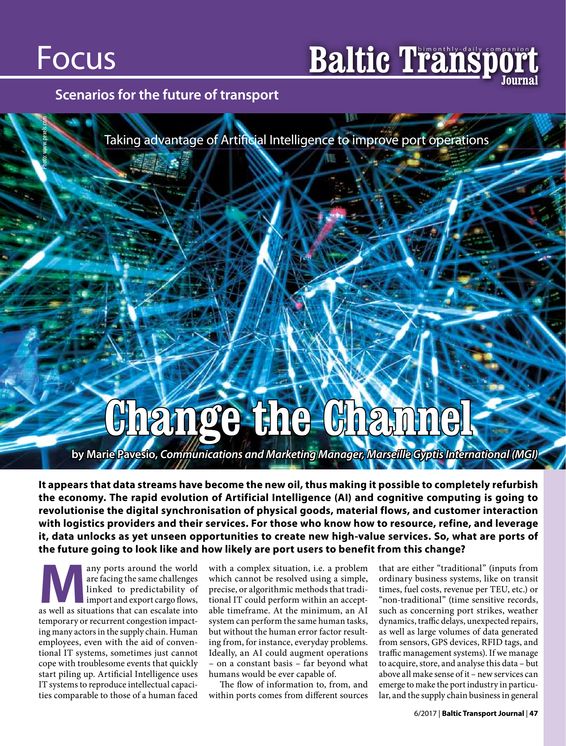
It appears that data streams have become the new oil, thus making it possible to completely refurbish the economy.
The rapid evolution of Artificial Intelligence (AI) and cognitive computing is going to revolutionise the digital synchronisation of physical goods, material flows, and customer interaction with logistics providers and their services. For those who know how to resource, refine, and leverage it, data unlocks as yet unseen opportunities to create new high-value services. So, what are ports of the future going to look like and how likely are port users to benefit from this change?
Change the Channel, by Marie Pavesio, Communications and Marketing Manager, Marseille Gyptis International (MGI)
The 6/2017 issue of Baltic Transport Journal in the Focus section features also:
- All aboard the AI train - or not? Are businesses ready to integrate Artificial Intelligence?, by Andrzej Urbaś
Artificial Intelligence (AI) is no longer a concept reserved for science fiction. The scale of its applications is vast and growing by the day - market analysis, customer service, marketing, even toys. And yet, while AI seems to be omnipresent in today’s business reality, there is also a massive gap between companies who believe this technology to be the way of future and those who actually act to implement it.
- What will it look like? A port of the future, by Maciej Kniter
We would all like to know the answer to this question. Some hints may be found in the paper provided by Trelleborg Marine Systems Preparing for the port of the Future, as well as in the presentation by Indra Vonck, Deloitte Port Services, titled Ports of the future. A Vision – both based on surveys. Let’s then examine how ports can change in the decades ahead.
- Low-carbon shipping. In the pipeline or still a pipe dream?, by Bartosz Dąbrowski
What will sea shipping look like in 2050? If we prick up our ears to what the developers of the Internet of Things and big data, or future-oriented naval designers have to say, then the answer seems to be simple: faster, better organised, more efficient, and more reliable. But, since the signing of the Paris Agreement in 2015, another question has been on everyone’s mind: at what environmental cost will these goals be accomplished? That the industry must become greener is simply a fact. How exactly it is going to achieve that? Well, that’s a different cup of tea.
Download PDF