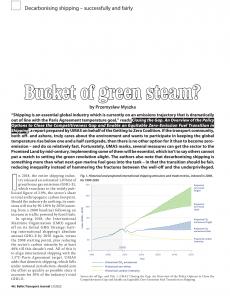
"Shipping is an essential global industry which is currently on an emissions trajectory that is dramatically out of line with the Paris Agreement temperature goal," reads Closing the Gap. An Overview of the Policy Options to Close the Competitiveness Gap and Enable an Equitable Zero-Emission Fuel Transition in Shipping, a report prepared by UMAS on behalf of the Getting to Zero Coalition.
The sustainable ship recycling consultancy, Sea Sentinels, believes the proposed changes to the EU's Waste Shipment Regulation (WSR) will bring "legal clarity" on hazardous waste exports that will benefit South Asian ship-breaking yards seeking compliance with EU recycling standards.
The Baltic Ports Organization's (BPO) annual debate held at the European Parliament (EP) tackled the impact of the war in Ukraine and the plans to reduce dependency on Russian energy sources in the context of possible consequences for the Baltic and European port industry.
To achieve the greenhouse gas emission (GHG-E) reduction goals outlined in the European Green Deal, the aim of which is for Europe to be the first climate-neutral continent, the maritime shipping industry must reduce its footprint: by 50% by 2030 and 90% by mid-century.