

by Przemysław Myszka
The summer issue should, apparently, start with something about the weather - though it's probably early autumn when you're reading this. And that's actually what links the two. Alright, we had a few heat-wave days in north-central Poland too, fair enough, but the summer of 2026 was in many places across Europe, including its northern regions, one massive, never-ending, here-to-melt-your-brain-out, scorching thermal onslaught. It was thus a bit of a tone-turbulence sharing with partners from Germany or the UK that one could endure here a bone-chilling bike ride in the morning, courtesy of milk-thick fog, ahead of a day that wasn't all that warmer, for good measure sprinkled with rain, wind, a leaden sky - and whatever else Mother Nature felt like tossing in (a touch over-generously).
Another pair that connects two seasons are BTJ Trips. First, towards the end of spring, Rostock invited us to visit their seaport, also granting the opportunity to interview, what's quite unique in the port industry, their two managing directors. Next, in mid-August, we jumped on board Skania, one half of the duo that has been put by POLSCA Baltic Ferries (a brand that also unites two shipping lines) on the newly created Gdańsk-Karlshamn crossing. Transport folks? Quayside, captain's bridge, rail siding, manufacturing site - we'll come to you. Got a story? Let's make it loud!
Other than that, this year's 3-4 issue is lavishly packed with reads on a variety of topics. The newest column, Safety, goes through the hidden security risk at the port-to-anchorage interface, what dog-tired seafarers actually need, as well as a simple yet effective innovation developed here in the Baltic (and already being exported overseas). Legal explains why even such a mundane thing as a mooring line can become a bone of contention - and by doing so, points to the importance of paying attention to the tiniest details. Focus, this time on shipping operational expenses, is also the theme of Economy.
One Sustainability piece makes the case that future marine bunkers need not only increased production thereof but also a marketplace infrastructure for wider adoption. Another explains why Europe's Industrial Maritime Strategy shouldn't focus on alternative fuels only (spoiler alert: it should also target methane slip). The third goes into ammonia's competitiveness, while the column's closing one focuses on building the vessels of tomorrow - today (with a regulatory framework still in the making or without fuel pathway maturity). As a case in point, Maritime details the relation(ship) between hydrodynamics and energy-efficiency improvements. Then there are two articles that share weather in common - and how it impacts shipping performance.
Technology, somewhat perversely, asks whether the industry is drowning in the sea of data or is it still stuck in the dark ages (nothing says ‘progress' like ‘blindly folded into the blue'). And as the closing highlight - the Baltic Ports Organization shares findings from their latest EU-backed project, this one about green shipping corridors (rare beast - one of those green initiatives that didn't wither away after a few years - hope somebody from the Commission is reading this... Oh, I almost forgot, there's a piece on the revision of the EU ETS, focusing specifically on the inclusion of the offshore shipping sector so it doesn't keel over).
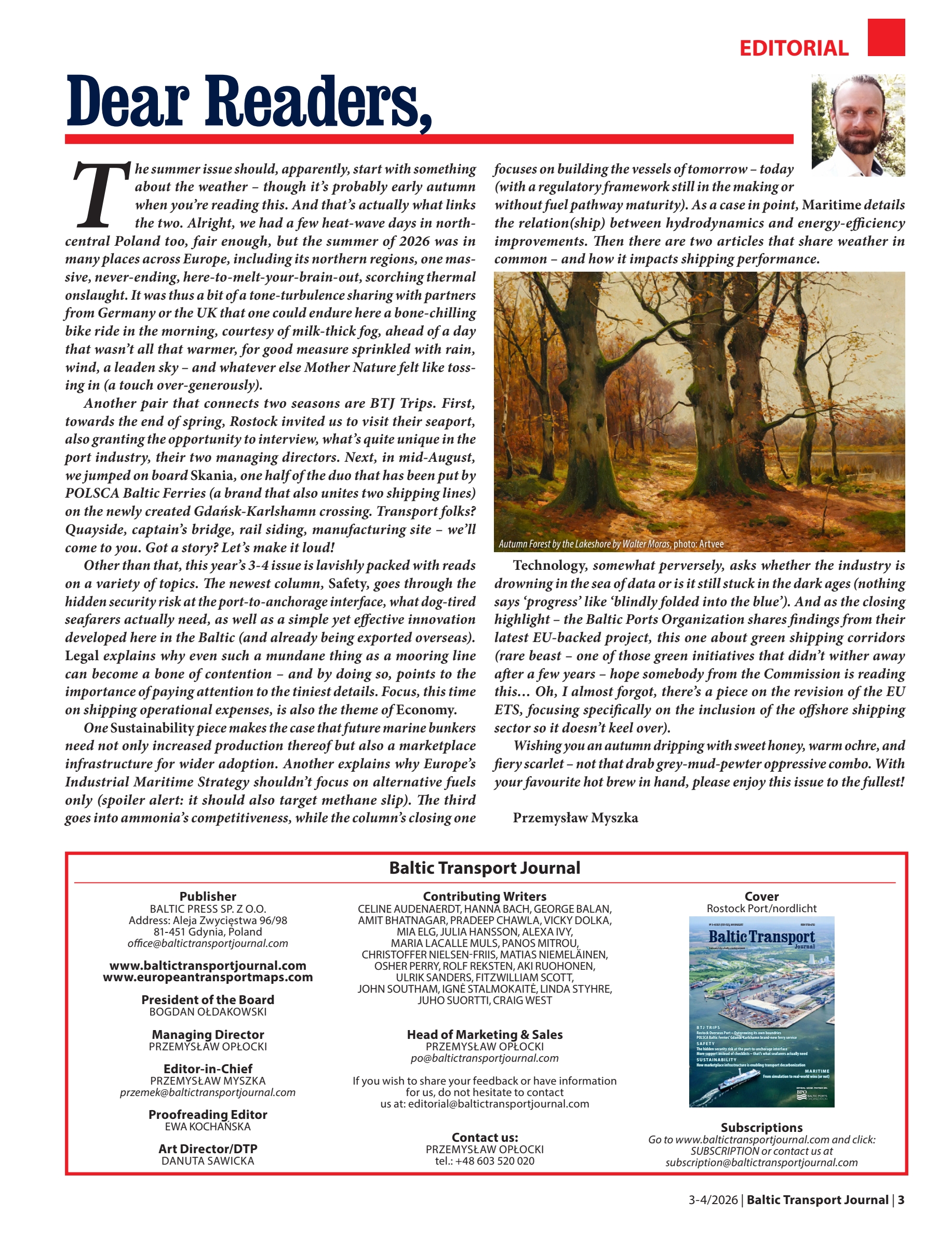
Wishing you an autumn dripping with sweet honey, warm ochre, and fiery scarlet - not that drab grey-mud-pewter oppressive combo. With your favourite hot brew in hand, please enjoy this issue to the fullest! Download PDF