

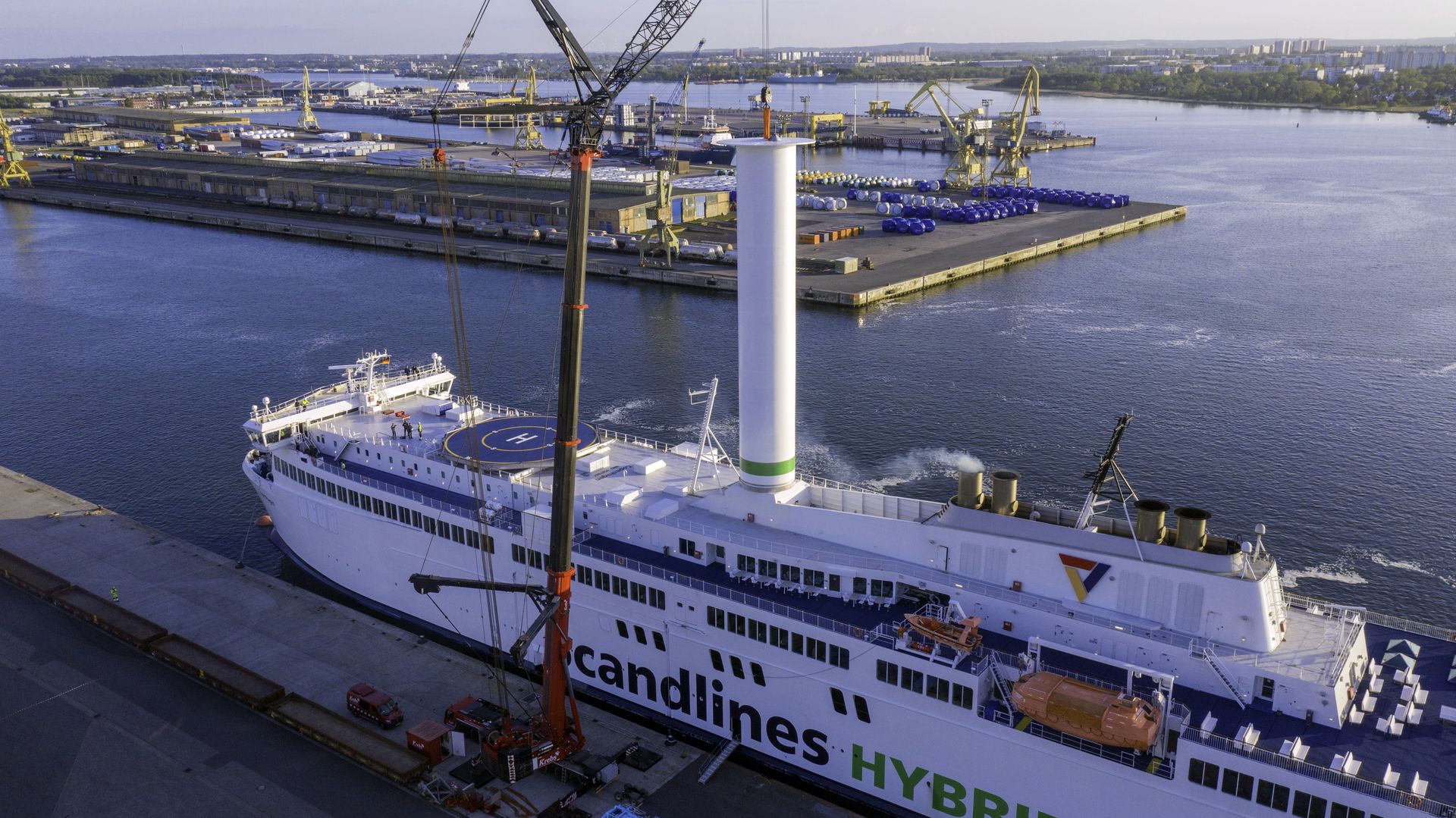
After a few months of preparations, Scandlines' ferry was equipped, within a couple of hours, with Norsepower's Rotor Sail during a scheduled overnight stop in the Port of Rostock.
The cylindrical sail is 30 m-tall and has 5 m in diameter. The solution is fully automated and detects whenever the wind is strong enough to deliver emission savings - in the case of Copenhagen an estimated 4-5% - at which point the Rotor Sail starts on its own.
"We are delighted to announce this latest successful installation of the Rotor Sail [the fourth completed by Norsepower], which demonstrates that retrofitting can be achieved without any interruption and downtime to day-to-day commercial operations," Tuomas Riski, CEO, Norsepower, said.
He added, "With increasing international regulatory and public pressure on the maritime industry to decarbonise, it is essential for the industry to recognise the value of one of the oldest forms of propulsion - wind. The market for wind propulsion is increasing, and this installation demonstrates how combining all methods of vessel optimisation is key to broader progress."
"We see huge value in investing in technology with the ultimate goal of reducing emissions. Working with Norsepower on this innovative solution was a perfect fit with our values and ambitions regarding sustainable shipping. On our modern, hybrid ferry, this solution will sit alongside hydrodynamic hull optimisation, and a hybrid electric propulsion system with a battery powered energy storage system, improving not only our efficiency but also profitability. We look forward to seeing the instant benefits of this technology," Søren Poulsgaard Jensen, CEO, Scandlines, highlighted.
Riski added to this, "Scandlines has a strong track record of investing in new clean technologies that save emissions on-board its fleet. The addition of Norsepower's Rotor Sail makes Copenhagen one of the world's most energy-efficient ferries."
Photo: Norsepower