

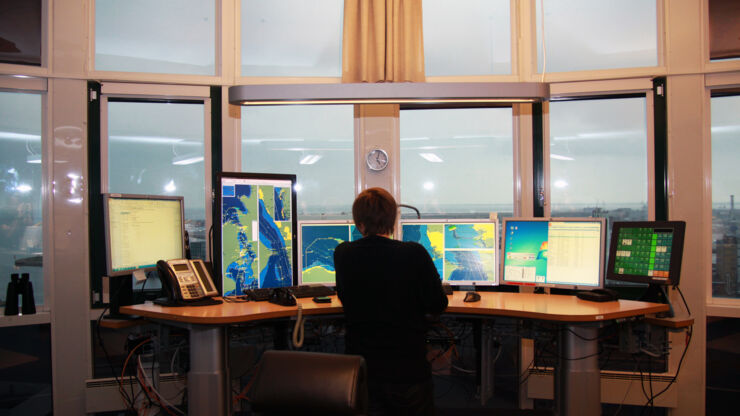
The two are going to jointly research more sustainable, efficient, and safe shipping operations based on technologies such as Artificial Intelligence (AI) and interactive visualisation.
The aim of the research collaboration - encompassing four research projects, three of which will be led by the Linköping University's Department of Computer and Information Science and the Department of Science and Technology - is to digitalise and make more efficient the working methods used at four of the Swedish Maritime Administration's vessel traffic service centres that each year manage thousands of traffic situations in Sweden's busiest maritime areas.
The Automated Monitoring (AutoMon) project will use AI for detecting deviations from normal traffic patterns, even outside of areas governed by traffic centres, in order to prevent accidents at sea.
Sensitive Automation (F-AUTO) is another AI project in which traffic will be analysed in real-time to warn the operator of potential conflicts they haven’t dealt with.
VASA is a project tasked with digitalising and making the process of approaching Swedish ports, with the use of AI and interactive visualisation, more efficient.
Lastly, the RESKILL project has been launched to increase operator expertise using a new concept for training with interactive visualisation. The system is to support the operators' ability to understand and recognise situations in which the automatic systems have not functioned as expected.
"There is a huge unused potential for maritime transport to relieve pressure on the overloaded railway network and reduce road congestion. We and the Swedish Maritime Administration will benefit from each other's expertise, and can bring huge advantages to society," Martin Rantzer, Head of the Department of Science and Technology at Linköping University, said.
Anders Johannesson, Senior Adviser, the Swedish Maritime Administration, added, "The work and research with Linköping University will in the long run not only prevent maritime accidents, but also increase our expertise in the field."
Jonas Lundberg, Professor of Human-Centred Design at Linköping University, also pointed out, "It is important that both the data and the automatically generated support information for important decisions can be clearly presented for humans. This is why we are working with how information can be efficiently visualised, while at the same time automatically analysed."
Photo: Swedish Maritime Administration