The 1,400 TEU-big vessel belonging to the Finnish short sea operator Containerships, part of CMA CGM, received its first batch of liquefied natural gas (LNG) in the Port of Rotterdam on 24 January.
The ferry company and the university, both based in Tallinn, have started a two year-long €100k scientific collaboration, the aim of which is to develop technologies for making car deck operations more efficient.
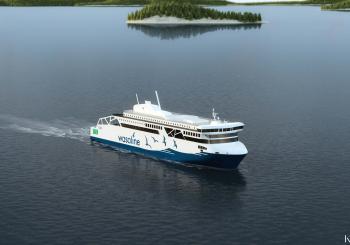
Kvarken Link has commissioned the Finnish Rauma Marine Constructions (RMC) shipyard to deliver a brand-new ferry to ply between Vaasa in Finland and Umeå in Sweden.
The Świnoujście-Ystad Maritime Link project has received €34m from the European Commission, which will cover approx. 26% of all expenses, set to amount to €132m.
The Swedish company serving ferry traffic in the Stockholm archipelago has put in operation Yxlan, a diesel-electric vessel built by the Estonian Baltic Workboats and equipped with a hybrid drive from Danfoss Editron.
The company has leased out three brand-new freight locomotives manufactured by the Polish Newag, which will be chiefly used to carry dry bulk goods on the routes connecting southwest Poland with OT's sea terminals in Gdynia and Świnoujście.
The Danish shipping company and the Turkish Ekol Logistics have agreed to further develop their cooperation regarding sea freight transports between Italy and Turkey.
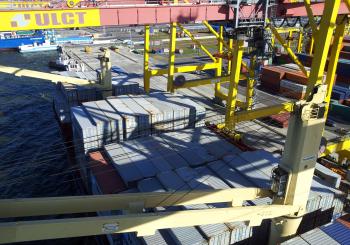
Following the installation of protection screens, coal dust suppression equipment, and air & water quality monitoring systems, the Ust-Luga Container Terminal (ULCT) has started taking care of coal shipments.
The SeaShuttle project has been awarded €6m by the government of Norway to work on launching onto the market autonomous container ships powered by fuel cells.
Effective from 1 January, trains on the Duisburg-Gądki/Pruszków route stop at the CLIP Intermodal Container Terminal in Swarzędz instead of Gądki and at PKP Cargo Connect's facility in Warsaw-Praga in place of Pruszków.