Ask most shipowners what comes to mind when they hear "biofouling," and the answers are predictable: drydock headaches, hull cleaning costs, and operational delays.
When I started 21 Knots in 2014, the conversations I had in yards and boardrooms were mostly about ship design effectiveness and cost-efficiency. Those same conversations are now shaped as much by economics and energy markets as by hydrodynamics and engineering.
For the maritime industry, environmental accountability represents one of the most important factors in shipowners' and operators' decision-making, the impact of which will resonate for decades to come.
After nearly half a century in the seaport and shipping business, the longstanding chief exec of the Finnish Port of HaminaKotka, one of the country's distinguished Port Counsellors, and chair of the Baltic Ports Organization - and truly a friend of our journal! - made his mind up to swap meetings for mornings (and other leisure pursuits of the legendary years).
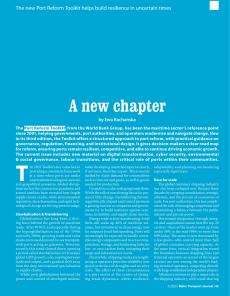
The Port Reform Toolkit, from the World Bank Group, has been the maritime sector's reference point since 2001, helping governments, port authorities, and operators modernise and navigate change.
The Finnish maritime industry, including ports, is being influenced by many of the same change factors as elsewhere, but there are also some unique features among them.
Few people give much thought to the cables and pipelines that run unseen across the seabed. Yet in the Baltic Sea, these silent arteries are every bit as strategic as ports, airports, and railways.
Flanked by NATO allies and partners, the Baltic Sea is one of the world's most strategically important waterways. It is a vital corridor for commerce, a flash point of great-power competition, and home to the undersea pipelines & cables that power Europe's energy and digital economies.