

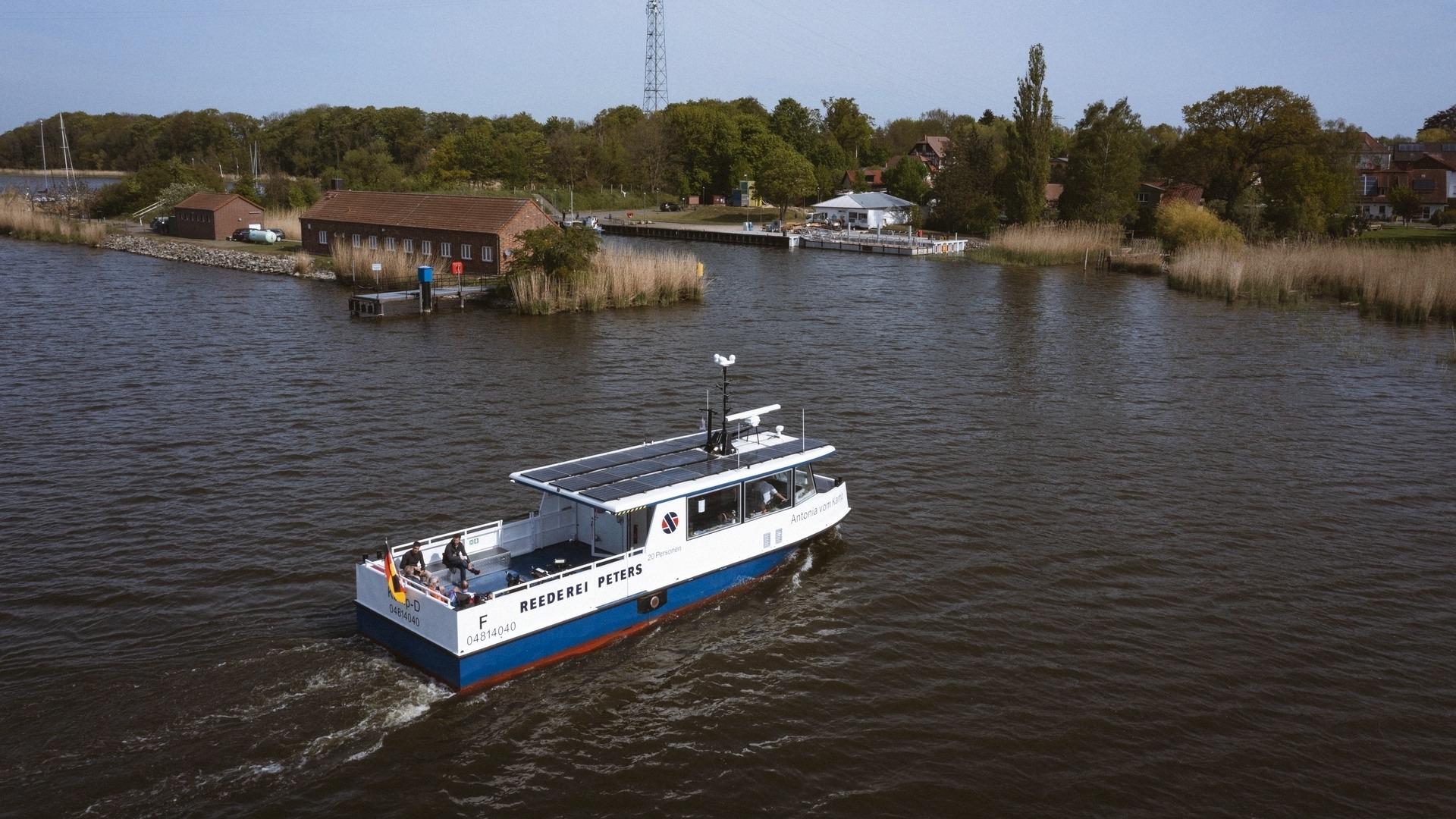
The 14.65 m long boat has started traffic between the village of Kamp on the German mainland and the island of Usedom, part of the 350 km Berlin-Usedom cycling route.
The newbuild has been put in place of a diesel ferry, the operating licence of which was withdrawn a couple of years ago.
"People still arrived on bicycles and wanted to get on the ferry. But then they realised: the ferry was gone. For our tourism, it was a disaster. Really tough," said Siegfried Henck, presiding over the local harbour association, which decided to organise a new, this time non-diesel ferry service.
Antonia vom Kamp is propelled by a single Torqeedo 60 kW Deep Blue electric azimuth thruster, which draws power from two Deep Blue batteries (80 kWh) and a 4.3 kWp solar installation. Her operating speed is 8 km/h, while max - 15 km/h.
According to her constructors, Ostseestaal and Ampereship, the solar-electric propulsion system will save some 20t of CO2/year.
"We can cover our energy needs almost entirely with the photovoltaic system. Electric motors only consume energy when the ship is moving. Here we have no gearbox, no losses, nothing. The ongoing costs in terms of maintenance, oil changes, and spare parts are much lower," Kay Peters, Managing Director of Oderhaff Reederei Peters, the ferry's operator, highlighted.
Tommi Salonen, Torqeedo's SVP Sales, added, "When you take a ferry out of operation for maintenance, you're losing money every minute. Solar-electric water taxis and ferries are more than just clean and green."
Photo: Christian Brecheis