

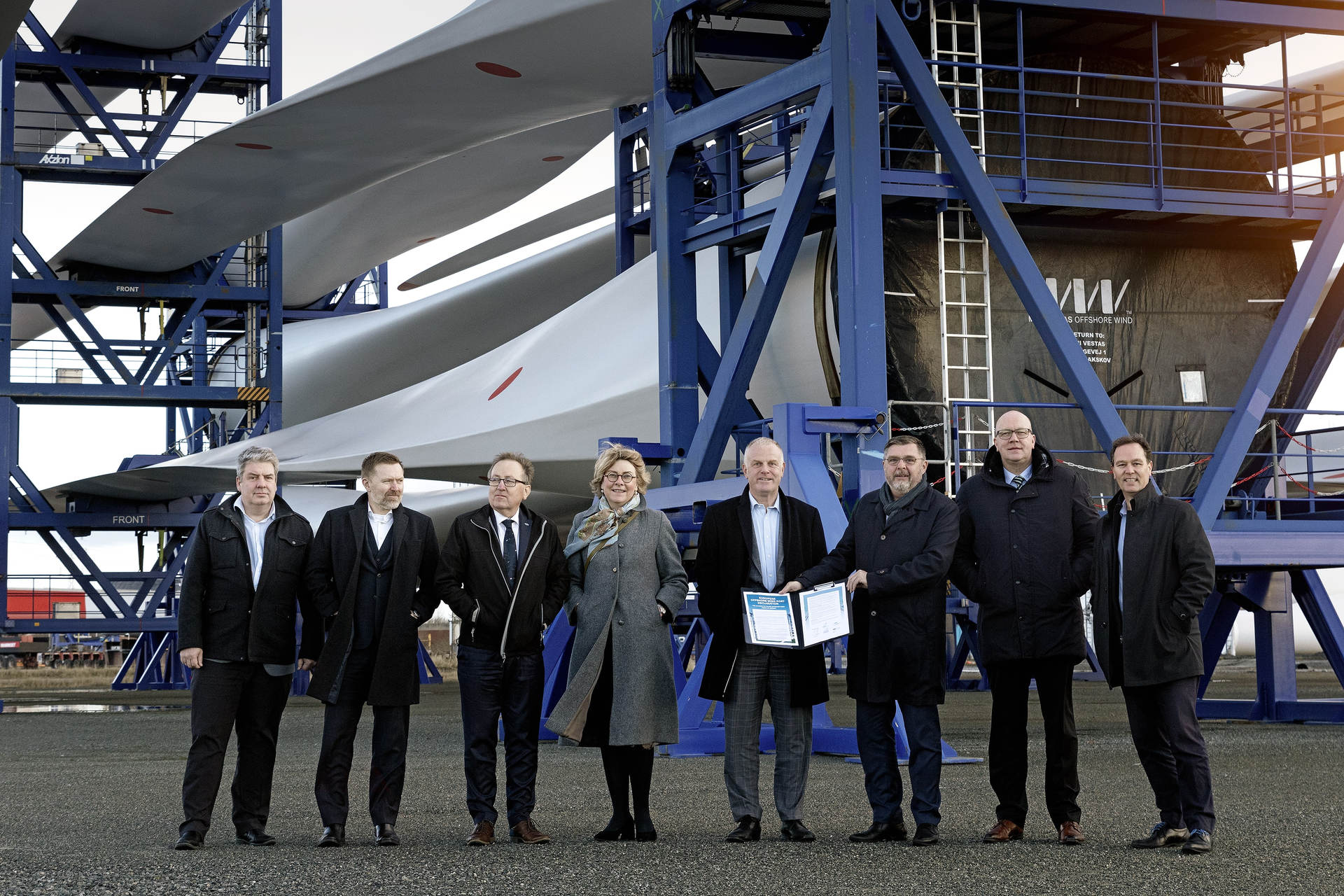
The ports of Cuxhaven, Eemshaven, Esbjerg, Humber, Nantes-Saint Nazaire, and Oostende have joined forces to speed up the green transition to meet Europe's offshore wind deployment targets.
"Today, the six of us signed a declaration stating that we will do everything we can to support Europe's ambitious aims. In May, the politicians set the framework with the original declaration, and today we've started to act on the challenge they gave us all by raising sky-high the targets for offshore wind," Dennis Jul Pedersen, the Port of Esbjerg's CEO, commented on the occasion.
The Esbjerg Declaration from May 2022 saw Belgium, Denmark, Germany, and the Netherlands pledge to deliver a minimum of 65GW of offshore wind energy capacity by 2030.
"[...] In other words, Europe aims to install well over five times as much offshore wind in the next eight years as we have built during the previous twenty years. This target puts great pressure on European wind ports because there is currently not enough port capacity to install all these offshore wind farms by the deadline," said the signatories of the European Offshore Wind Port Declaration in a press release.
The parties will share best practices, e.g., using the digital twin to increase handling capacity without physically enlarging their harbours. They will also collaborate on getting around the issue of, e.g., space shortages, such as when one port only has space for half a project, another may have room for the other.
"The green transition poses an enormous challenge for all European players in the offshore industry, so a stable alliance is key to success. Even though we're competitors, we still face the same challenges and have a joint responsibility to achieve the political demands and market requirements," Holger Banik, Managing Director at Niedersachsen Ports (the port authority managing Cuxhaven), commented.
Dirk Declerck, the Port of Oostende's CEO, said, "This collaboration is important, because we make each other stronger. Likewise, it is very important for the green transition that we exchange knowledge and experience and share professional information with all stakeholders in the offshore industry, so we can create a professional platform."
Olivier Tretout, CEO of the Nantes Saint-Nazaire Port, underlined, "We're new to the offshore wind industry, and we're very proud that we've recently completed the first ever offshore wind farm in France. So, we're looking forward to drawing on the experience of the other ports and to contributing knowledge based on our focus on floating offshore wind farms. We also hope that the partnership will contribute to finding solutions to the bottlenecks we're all facing."
Andrew Reay, Head of Offshore Wind at Associated British Ports (ABP, running Humber), also shared, "ABP is the UK leader in supporting the growth in offshore green energy, particularly today on the Humber where we already host major manufacturing facilities and operations and maintenance bases. We're excited to be working with leading peers across Europe to unlock the significant potential of offshore wind to decarbonise the UK."
"We're now joining forces to find the best solutions for optimising the ports in the offshore industry [...]," Erik Bartholet, Business Manager, Logistics and Offshore Wind of Groningen Seaport/Eemshaven, summed up.
The European Offshore Wind Port Declaration was underwritten in the presence of Isabelle Ryckbost, Secretary General of the European Sea Ports Organisation (ESPO), who said, "The importance of ports in Europe should not solely be calculated in tonnes, but should also be assessed in terms of their contribution in the deployment and supply of energy, in particular renewable energy. I am very excited to see these six important wind energy ports joining their efforts and leading the way in view of reaching the EU offshore goals. Through cooperation it will be easier to face the identified headwinds."
Photo: Port of Esbjerg