

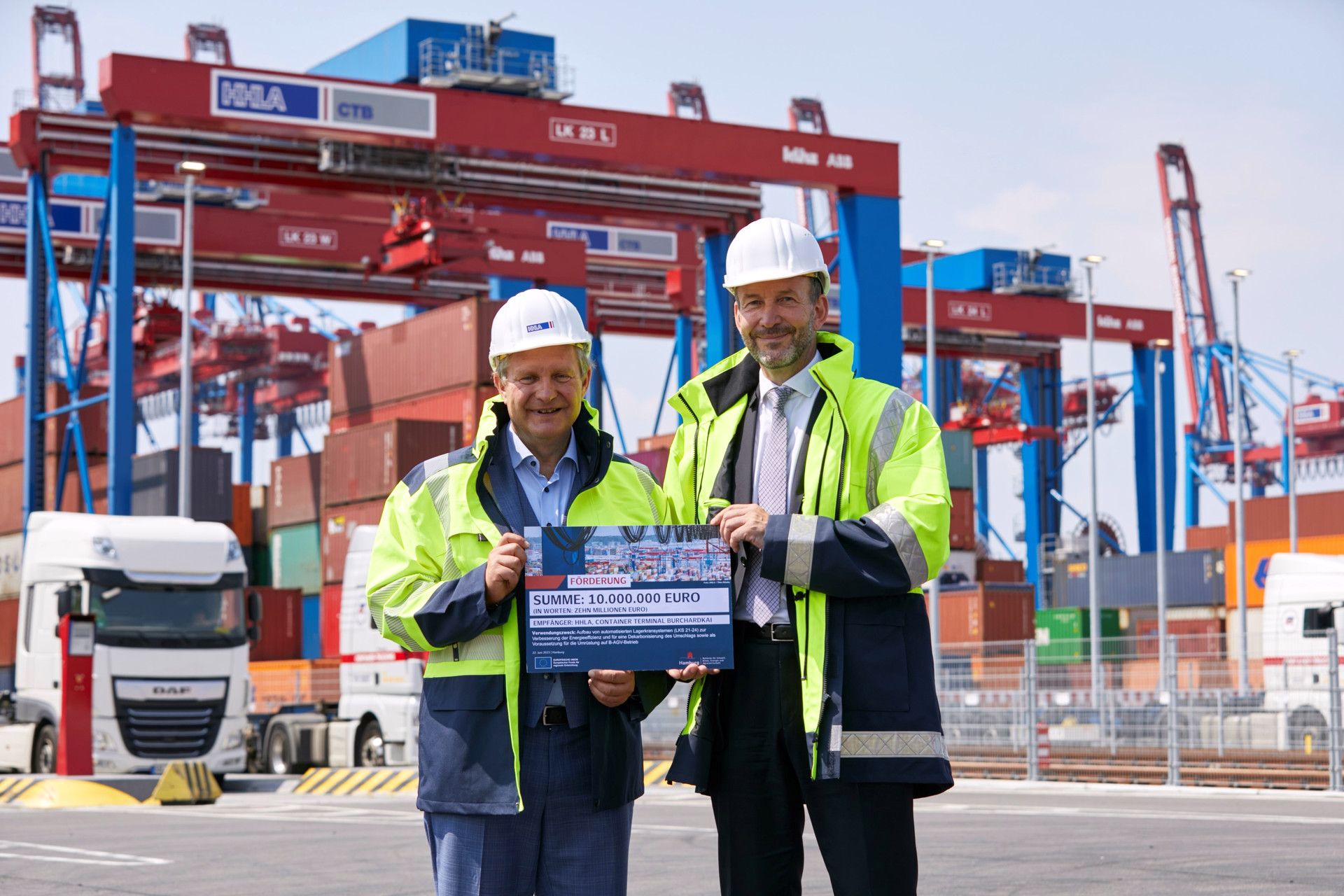
As a result, HHLA's Container Terminal Burchardkai (CTB), operating in the Port of Hamburg, comprises 19 storage blocks, offering 39k TEUs of automated container yard capacity.
The new 8.5k TEUs in total blocks were gradually put into operation over this year's first half. HHLA is already adding three more to be up & running at the beginning of next year.
CTB's automated container storage consists of 375 by 42 m storage blocks, arranged side by side, with a capacity between 1,980 and 2,130 TEUs.
The storage crane system consists of three portal cranes that can drive over each other.
The storage's IT system is integrated into the terminal's overall control system. It has been supported by a specially-developed artificial intelligence module for several years that helps it find optimal storage locations, which can reduce the energy-consuming re-stacking of containers.
HHLA says that the switch also creates the conditions for converting horizontal transport to fully-automated container transportation with the help of battery-run automated guided vehicles.
"By using new technologies, we want to fully electrify the container handling process at CTB, our largest terminal in Hamburg, while significantly improving our energy efficiency. Using electricity from renewable sources will allow us to continue decarbonising our workflows at the port. We previously demonstrated how this can work at the neighbouring Container Terminal Altenwerder. The switch to environmentally friendly storage crane systems will bring us a big step closer to this goal," underlined Jens Hansen, Member of HHLA's Executive Board.
Jens Kerstan, Hamburg's Minister for Environment, Climate, Energy and Agriculture, also highlighted, "Climate protection begins locally. With the start-up of the fourth automated storage crane system, we have achieved a milestone on our path towards decarbonising Container Terminal Burchardkai. This project will save almost five and a half million litres of diesel and 11,000 tonnes of CO2 every year. And there's more: electrified storage cranes are not only significantly quieter; they allow a considerable amount of soot, particulate matter and nitrogen to be avoided. This directly improves the quality of life of Hamburg's residents, especially in areas close to the port."
He furthered, "The ten million euros from the European Regional Development Fund were optimally invested here. The project gives considerable momentum to the modernisation of container handling, makes a long-term contribution to climate protection and demonstrates impressively that increased capacities can be achieved with lower emissions. In Hamburg, we want to live and do business in a carbon-neutral manner by 2045. It is essential that everyone in politics, the scientific community, business and the general public pull together with all our strength. Projects with charisma, such as this one, are particularly motivating."
Photo: Rolf Otzipka/HHLA