

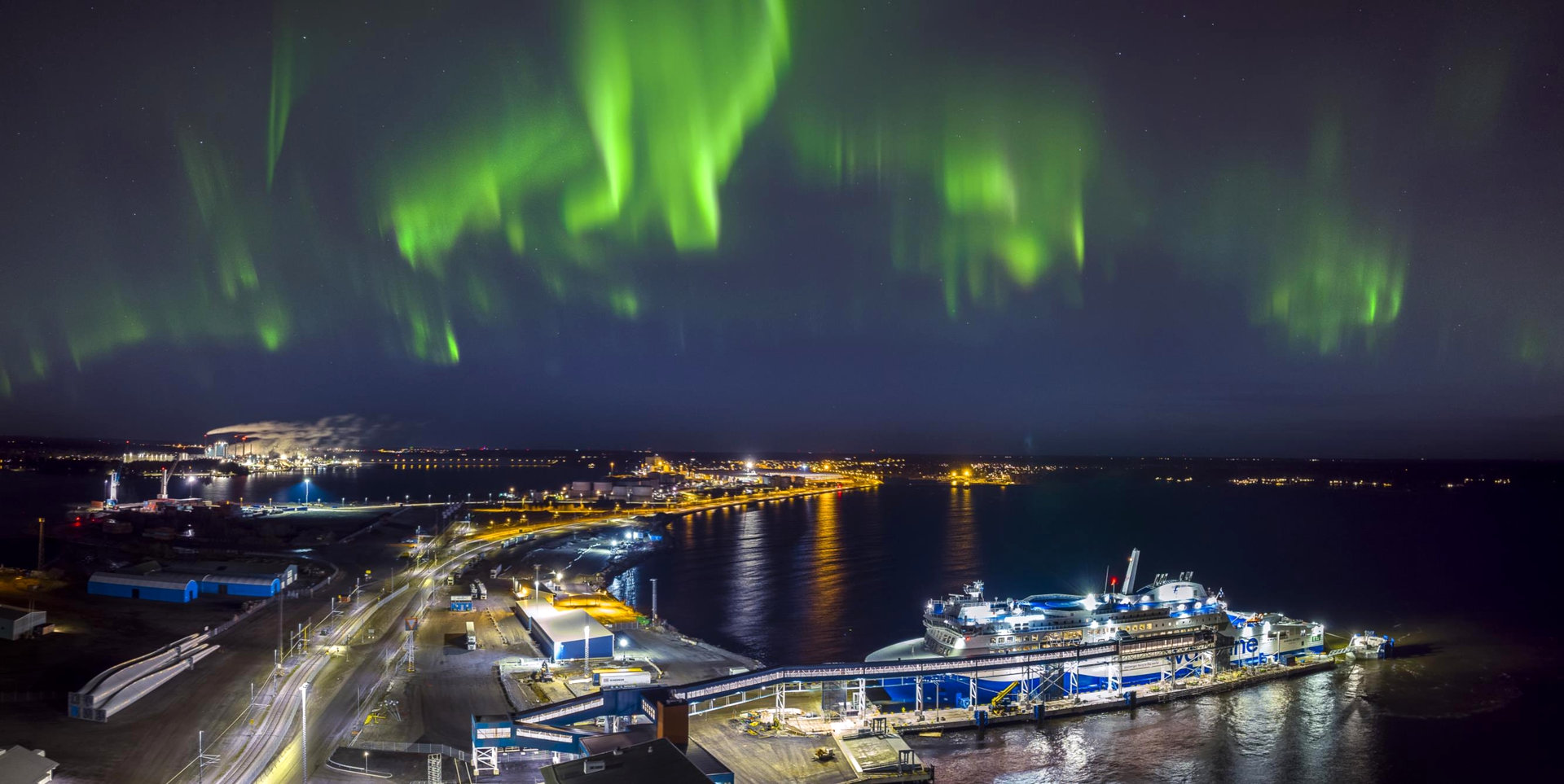
Within the EU-co-funded Blue Supply Chains (BSC) project, the Swedish Umeå and the Lithuanian Kaunas are redefining the future of green shipping.
Two ambitious initiatives - Sweden's roadmap for a climate-neutral seaport in Umeå and Lithuania's electrification of the Nemunas River - are setting a new standard for sustainable maritime transport. Both projects demonstrate how innovation, local energy resources, and strategic planning can speed up the transition to zero-emission logistics across Europe.
The Swedish case
The City of Umeå has unveiled a detailed plan to reach climate neutrality by 2040, including the transition to renewable fuels in port and transport operations. Developed by IVL Swedish Environmental Research Institute together with the Port of Umeå, Umeå Energy, Umeå Municipality, and Infrastruktur i Umeå (INAB), the roadmap envisions replacing fossil fuels with locally produced green hydrogen and electro-methanol. Umeå's strategic advantages include access to abundant sources of renewable electricity (hydro & wind), biogenic CO2 (from district heating) and clean water for hydrogen electrolysis, as well as robust sea & rail transport infrastructure.
Projections show that a large-scale production plant in Umeå Eco Industrial Park could supply up to 110,000 tonnes of e-methanol annually by 2030. The ferry line Wasaline, which plies between Umeå and the Finnish Vaasa, has been identified as a key early adopter. Other players, including SCA through their fleet renewal, will also support the long-term emission cut ambitions. The analysis included three strategic scenarios, with Umeå most likely becoming the export hub for renewable fuels - exceeding initial domestic demand.
The Lithuanian case
Through the Lithuanian Inland Waterways Authority project, Lithuania is set to transform its inland waterway transport by electrifying the Nemunas River corridor between Kaunas and Klaipėda. Backed by EU and national funding, this initiative will eliminate over 48,000 truck journeys per year, significantly cutting CO2 emissions and congestion. Since 2019, over €27 million has been invested to modernise the E41 waterway, rebuild infrastructure, and enable year-round shipping. Each barge replaces 106 trucks and saves 21 tonnes of CO2 per trip.
Lithuania will also see its river tonnage & port infrastructure upgraded with six electric pushers, 12 cargo barges, 27 battery containers, and three smart charging hubs - in Klaipėda, Jurbarkas, and Kaunas Marvelė. The country has committed to funding 90% of the grid expansion costs, enabling high-capacity charging (up to 750kW per vessel), and ensuring predictable long-term electricity pricing.
Decarbonisation by design
Both work teams assessed a range of clean propulsion options: battery-electric, methanol, hydrogen, and hybrid systems. In the Swedish case, e-methanol and hydrogen were prioritised for deep-sea and ferry use due to their energy density and decarbonisation potential. Though the latter poses greater infrastructure and safety challenges (a.o., the need for 1,000 bar storage, hydrogen-induced cracking), it’s still regarded as part of the long-term agenda.
In the Lithuanian case, battery-electric emerged as the fastest solution to deploy for inland waterways, offering simpler infrastructure and lower operational costs. Push boats with 660kW azimuth propulsion and 3.6-metre elevating wheelhouses are tailored for the Nemunas' unique conditions. Electro-balance modelling, simulations of computational fluid dynamics, and real-world testing have confirmed vessel performance and energy requirements in both regions.
Where infrastructure meets climate policy
Both projects emphasise the importance of infrastructure-readiness and regulatory support; in Sweden, for upgrading onshore power (OPS), providing future-fuel bunkering, and integrating carbon capture (operational by 2029), while in Lithuania, for reinforcing port docks, adding cranes for handling those 30-tonne battery containers, and securing fixed-rate electricity contracts. EU rules, like FuelEU Maritime and the inclusion of shipping in its Emissions Trading System, will further drive the adoption of clean fuels, according to the project parties.
What's next
In the Swedish case, in 2027, the rail link between the seaport and the Umeå Eco Industrial Park will be completed; carbon capture operations will be in full swing two years later; in 2030, e-methanol production will kick off; in 2040, full port and municipal climate neutrality will be achieved.
In Lithuania, the public tender and construction of the first e-push boats are scheduled for this year; in 2026-27, the Klaipėda-Jurbarkas-Kaunas Marvelė charging stations will go live; and in 2030, the complete inland waterways fleet will become operational.
From Baltic innovation to global impact
Both roadmaps highlight that early grid and port infrastructure investment is key; that cross-sectoral collaboration improves cost control and roll-out speed; that tailored vessel designs outperform retrofits in green corridors; and that policy clarity and local leadership unlock funding and public support.
As Europe races to meet its climate targets, these two initiatives from Northern Europe prove that zero-emission shipping is not just a future vision - it's already underway. With complementary technologies, integrated energy planning, and strong governance, Lithuania and Sweden are offering scalable models for ports and rivers across the continent. Click here to access the BSC Umeå-Kaunas roadmaps.
Photo: Blue Supply Chains