As important of a role as international shipping plays economically, it is also responsible for significant environmental damage, ranking as the sixth largest greenhouse gas (GHG) emitter worldwide.
Offshore wind energy (OWE) is one of the leading topics in the maritime industry. For this reason, the Baltic Ports Organization (BPO) decided to take a closer look at this issue.
One area of ship operations that has attracted much attention in recent years due to the possibilities it represents for emission reduction is that of cavitation.
Over the past decade, technology innovations have fueled widespread digital transformation across global industries such as healthcare, telecommunication, and manufacturing.
In a collaborative effort, BM Bergmann Marine and the Fraunhofer Center for Maritime Logistics and Services CML have conducted an extensive study on autonomous maritime systems (AMS) on behalf of the German Maritime Center DMZ.
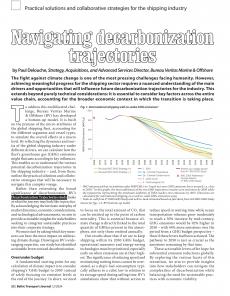
International shipping, which carries over 80% of the world merchandise trade by volume, accounts for approximately 3% of total greenhouse gas (GHG) emissions worldwide.
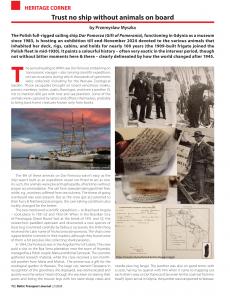
The Polish full-rigged sailing ship Dar Pomorza (Gift of Pomerania), functioning in Gdynia as a museum since 1983, is hosting an exhibition till end-November 2024 devoted to the various animals that inhabited her deck, rigs, cabins, and holds for nearly 100 years (the 1909-built frigate joined the Polish fleet in mid-1930).