

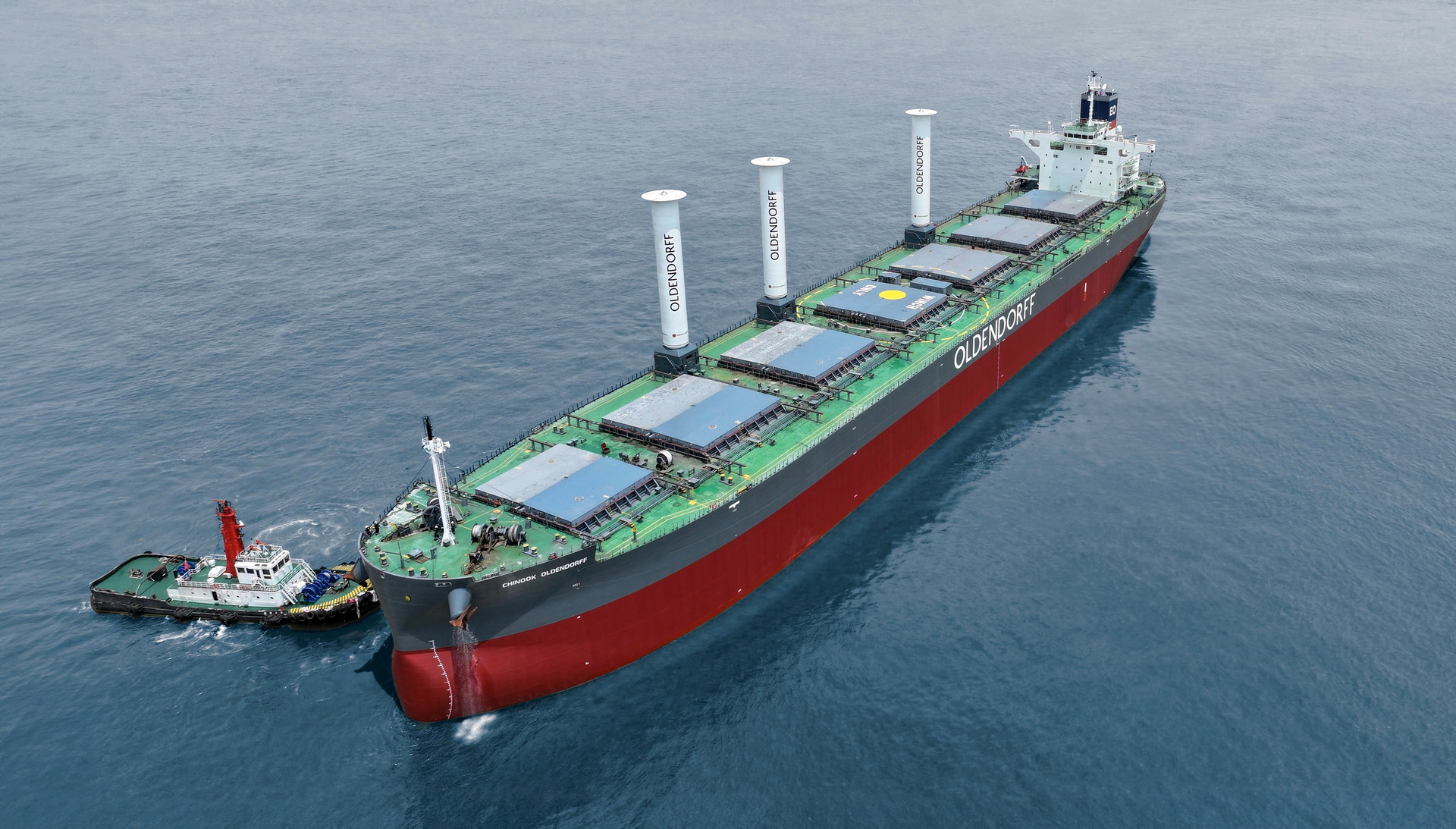
The headquartered in Lübeck company saw the installation and operational deployment of three Rotor Sails from the Finnish Norsepower on board the dry bulker Chinook Oldendorff.
These are expected to reduce the vessel's fuel consumption by about 10-15% on transpacific routes (Chinook Oldendorff carries Elk Valley Resources' steelmaking coal from the Port of Vancouver to customers across the Pacific Ocean).
"The collaboration with Elk Valley Resources on this project exemplifies how partnerships can drive meaningful progress. Chinook Oldendorff reflects our commitment to deliver practical environment conscious solutions that align with our clients' needs and our long-term sustainability goals," Russ McNeil, Managing Director of Oldendorff Vancouver, commented.
Jennifer Natland, Vice-President, Properties and Environment, Vancouver Fraser Port Authority, also said on the occasion, "We applaud Oldendorff Carriers and Elk Valley Resources for their leadership to reduce emissions from the shipping industry. Their innovative efforts are in line with the Vancouver Fraser Port Authority's ongoing commitment to environmental protection, and we are pleased to welcome Chinook Oldendorff at the Port of Vancouver."
"Originally built in 2020 as Dietrich Oldendorff, this Post Panamax vessel was renamed Chinook Oldendorff to reflect the synergy between the Rotor Sail technology and the natural wind patterns in the Pacific Northwest. The word 'Chinook' originates from the First Nations people of the Pacific Northwest, referring to a type of wind with coastal and inland variations. Coastal Chinooks are southwesterly winds blowing in from the ocean, while the inland Chinooks are warm, dry winds that descend the eastern side of the Rocky Mountains. The name references the innovative use of mother nature to lower emissions on the vessel's journeys," Oldendorff Carriers explained in a press brief.
Photo: Oldendorff Carriers