

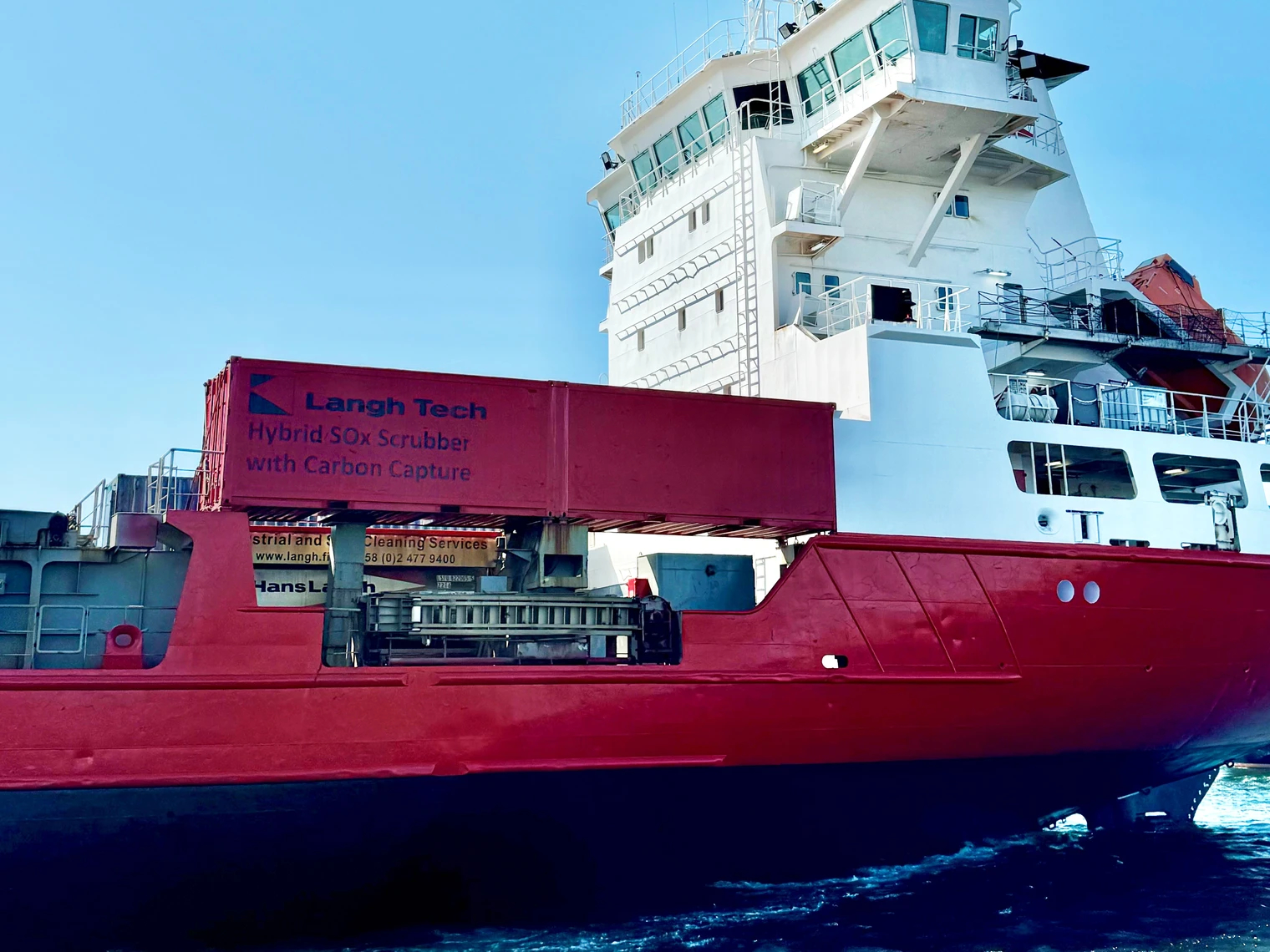
Following a trial on one of Langh Ship's vessels, the Damen Shipyards Group will install the company's system for onboard carbon capture (OCC) on four dry bulk carriers in 2025 (along with hybrid scrubbers).
"The pilot plant has shown that it is possible to [achieve] capture rates [of] over 80% from the exhaust gas flow coming into the system. The overall CO2-emissions can be reduced at least by 20 to 30%, depending on the available space, and other ship and product specifications," Langh Tech highlighted in a press release.
The Finnish tech company also underscored, "A unique feature of the system is the possibility to sell and utilise the sodium carbonate, which results at the end of the chemical process, for diverse applications in other industries [such as glass and detergent manufacturing]."
Langh Tech's OCC system applies a post-combustion technique, in which CO2-containing exhaust gases are directed into a capture unit. CO2 then dissolves into the liquid phase through a counter-currently flowing aqueous NaOH solution. The manufacturer says that a maximised surface area ensures the highest possible carbon capture rates. As a result of several consecutive reactions, CO2 is chemically bound into a thermodynamically stable product of sodium carbonate.
With "[...] post-combustion capture, there is no need for solvent regeneration or CO2 compression, which significantly reduces the additional energy consumption on board, as well as the resources needed to operate the OCC system. No additional specialised equipment is needed. In turn, the capture reagent, sodium hydroxide, can be produced by electrolysis of sodium chloride using renewable energy," Langh Tech explains.
The company also underlines that its OCC system is adaptable and scalable, and can be used with different ship types.
The bulker-installation is part of a project between Langh Tech, Atal Solutions, BAM Shipping, and the Damen Shipyards Group, the aim of which is to retrofit ships with different technologies for maximum CO2 as well as SOx and NOx emission reduction while using traditional fuels. The project's goal is to axe ship CO2 emissions by up to 60% with OCC (coupled with other measures, including voyage planning).
"The decision to choose Langh Tech was simple. CO2 capturing is the only economic way to drastically reduce emissions as of now. My main concern was the value of the CO2 end product being created on board the ship. Langh Tech delivered on every front: a high capture rate, a high-value CO2 end product, and a significant reduction in emissions. From a commercial perspective, it made perfect sense. On a personal note, we share the same vision and goal: to green the global fleet. That alignment made Langh Tech the natural choice," Rutger van Dam, Business Development Manager at the Damen Shipyards Group, commented.
Edwin Sieswerda, Founder and CEO of Atal Solutions, added, "This partnership with the Damen Shipyards Group and Langh Tech showcases how innovative collaboration drives meaningful change. Atal's vision and willingness to embrace bold solutions demonstrate how we can address the challenges of decarbonisation while unlocking economic and environmental benefits for the maritime sector. By investing in Langh Tech's onboard carbon capture technology, we're not just setting a new benchmark for sustainable shipping - we're also paving the way for future projects and ongoing transformation in the industry. It's a big leap, but one that aligns with our shared commitment to building a more sustainable future."
Laura Langh-Lagerlöf, Commercial Director of Langh Tech, summed up, "Our onboard carbon capture solution gives shipowners and operators the possibility to decarbonise and balance their costs. The scarcity and significantly higher costs of carbon-neutral fuels are a substantial hurdle to the decarbonisation of shipping. It will take time until those fuels can be widely used and afforded. We are here to bridge this gap and help companies to decarbonise efficiently and according to their abilities."
Photo: Langh Tech