

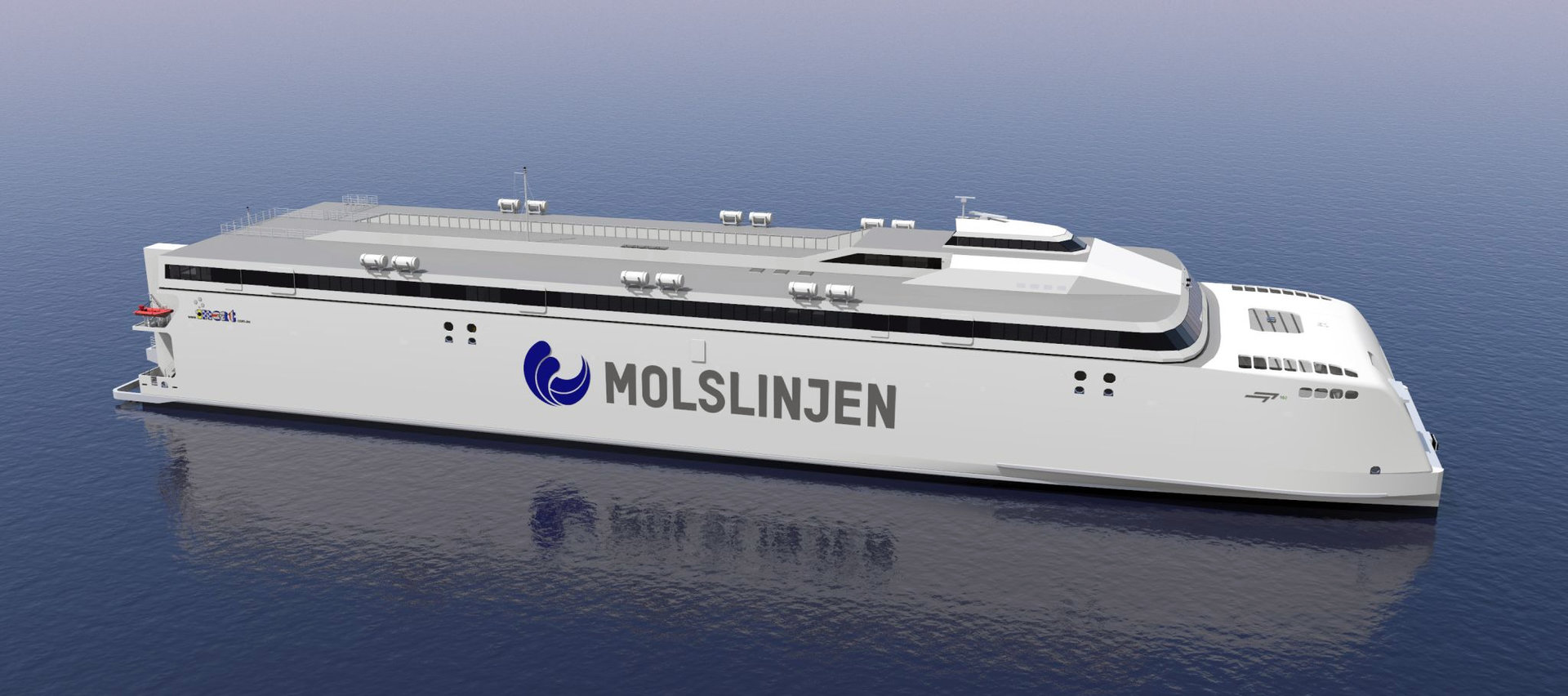
Each of the Danish ferry line's three brand-new high-speed catamarans, under construction at Incat Tasmania, will feature a 55MWh battery pack.
AYK signed the contract with the system integrator Wärtsilä, which will deliver the integrated electric propulsion system and waterjets.
The first 129-by-30.5-metre ferry, offering room for 1,500 passengers and space for 500 vehicles, will arrive in Denmark in late 2027 ahead of entering service between Jutland and Zealand in Q1 2028. Her sister ships will follow in 2028 and 2029. The 40-knot max-speed e-catamarans will be capable of high-capacity charging in about 30 minutes.
"This is genuinely an inflection point for electric ships. It is also the result of enormous hard work over more than a decade by those of us who have believed in electric ships," commented Chris Kruger, founder of AYK Energy.
He furthered, "AYK's approach has always been led by safety first. There is massive pressure to improve energy density and raw power, but this cannot happen overnight, especially in the rugged conditions of the sea. This is not a car where the driver can simply step out onto the road if there is a fire. This is the reason AYK secured the first type approval [by DNV] of LFP [lithium iron phosphate] battery technology, which is considerably safer than the previously used NMC [nickel manganese cobalt oxide] chemistry."
Kruger also underscored, "We decided to rethink the battery's design from the ground up to reduce weight [from 700 to 400 tonnes] and improve performance. With new battery cells, inspiration from manufacturing techniques in the automotive industry and a lighter, stronger aluminum structure, we can store more energy per kilogram and deliver more power. At the same time, we have adapted the technology to the specific requirements of the marine environment and integrated our patented solutions for fire suppression and limiting overheating within the battery modules."
Carsten Jensen, CEO of Molslinjen, said, "We are pushing the boundaries of technology here, and the combined weight of the vessel and its batteries will be crucial to operating such large vessels at high speed across the Kattegat. So when AYK managed to significantly reduce the weight of its batteries without compromising power, that tipped the balance. This provides a proven level of safety that is on a par with, or probably even better than, what we have with diesel today. This was also a decisive factor in our choice of supplier."
Dr Torsten Büssow, Managing Director - Electrical & Power Systems Business at Wärtsilä, also highlighted, "The speed how AYK is bringing latest LFP technologies into the marine industry is impressive. For large ferries, we have to find a balance between short high-power charging and long high-energy sailing times combined with a weight challenge on aluminum catamarans like these."
Photo: Molslinjen