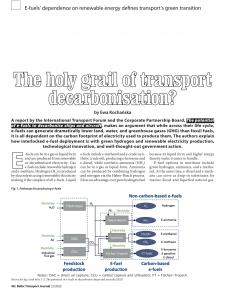
A report by the International Transport Forum and the Corporate Partnership Board, The potential of e-fuels to decarbonise ships and aircraft, makes an argument that while across their life cycle, e-fuels can generate dramatically lower land, water, and greenhouse gases (GHG) than fossil fuels, it is all dependent on the carbon footprint of electricity used to produce them.
Shipping has a long history of regulatory interventions to protect the environment, from the London Convention to MARPOL, through the Ballast Water Convention, and now the Energy Efficiency Existing Ship Index (EEXI) and the Carbon Intensity Indicator (CII).
The Baltic Sea region, with its unique environment and favourable conditions for path-breaking, is fast becoming a hotbed for maritime innovation development.
Another year is behind us, another one under our moving feet. The past 12 months wouldn't be terrible if it weren't for 24 February: rounding up last year's transport highlights felt like watching a split-screen, with two distinct realities flashing in front of our eyes.
Except for the Russian war of aggression against Ukraine and its impact on transportation - on which we reported several times throughout 2022, hence this round-up will omit that area the past year was more or less peppered with happenings taking place across two domains: shipping and all-things-green.
According to the Reconstruction of Ukraine report released by the Warsaw Enterprise Institute (WEI) in November 2022, a minimum of 750 billion US dollars will be required over ten years to recover the country from Russia's war of aggression launched on 24 February 2022.
According to the Reconstruction of Ukraine report released by the Warsaw Enterprise Institute (WEI) in November 2022, a minimum of 750 billion US dollars will be required over ten years to recover the country from Russia's war of aggression launched on 24 February 2022.