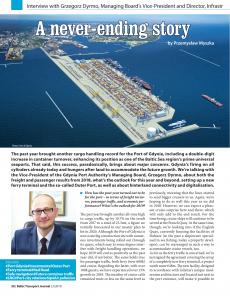
The past year brought another cargo handling record for the Port of Gdynia, including a double-digit increase in container turnover, enhancing its position as one of the Baltic Sea region's prime universal seaports.
The past year brought about a number of developments across the Russian seaborne transport market, most notably in relation to shipping across the Northern Sea Route (NSR) and exports of liquefied natural gas (LNG) from the country's fields in the Arctic.
It was yet another peaceful year across the Baltic Sea region. No SECA-like regulations, trade wars, rampant spikes in the price of bunkers, or racking disputes between trade unions and terminal operators, just good ol' transport and logistics.
"Inland waterway transport (IWT) is a green, smart transport mode, well-integrated in multi-modal supply chains with a remarkable share in the modal split." That is the vision for IWT in the Baltic Sea Region championed by project EMMA, co-funded by the Interreg Baltic Sea Region Programme, ever since it kicked off in March 2016.
TT Club, in conjunction with BSI Supply Chain Services and Solutions, has launched the first joint Semi-Annual Global Cargo Theft Intelligence and Advisory Report.
The third instalment of the seminar devoted to the topic of onshore power supply (OPS) - organised by Actia Forum within the premises of the Port of Oslo and with the help of ABB, the event's Gold Sponsor, as well as Schneider Electric and STEMMANN-TECHNIK - couldn't have found a better host, as this year Oslo is the European Green Capital.
The maritime industry finds itself amid a perfect storm of economic stresses, regulatory changes, and technological disruption. This situation is forced upon it by a combination of cut-throat competition, strained financial performance in many shipping segments, and a strong need to reduce the industry's environmental footprint.