According to Alexander Pinskiy, General Director of the Moscow-based hi-tech marine association MARINET, shipping companies will be able to commence operations of Russian-flagged autonomous vessels as early as 2021.
Being a European manufacturer with many years of experience of doing business internationally, you might have been wondering how to increase and control your sales in Russia, and, on a wider scale, also throughout the Commonwealth of Independent States (CIS).
The TER4RAIL project, financed by the EU-backed SHIFT2RAIL initiative, is working on a research programme titled "Rail as Benefit to EU Society," and has carried out surveys, data-mining, and analyses of future change drivers.
Nay, this isn't some tick-off guide list for maritime travellers nor a WW2 Pacific island invasion playbook, though to be honest, the chart may give the impression that a voyage on the highest deck of a ferry might deliver the opportunity to collect the whole depicted lighthouse portfolio, either in fond memories or a selfie.
Hold your horses! While at first glance it might appear that the regional port market struck yet another record - having advanced by 1.1% year-on-year to a total of almost 952.58 million tonnes in 2019 - there is one all caps, glaring, and extremely concerning caveat, namely the unavailability of hard data from at least a portion of the statistical offices.
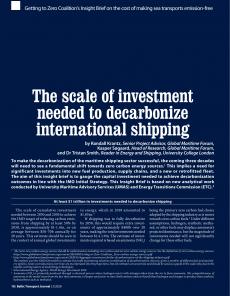
To make the decarbonization of the maritime shipping sector successful, the coming three decades will need to see a fundamental shift towards zero carbon energy sources.
Once the coronavirus (COVID-19) pandemic is, hopefully, overcome, it'll be synonymous with a black swan, an unexpected force majeure event that rolls through everything like a thunderstorm, leaving virtually none negatively unaffected.
The IMO 0.5% sulphur cap is now in force globally, while the Poseidon Principles, a banking code aimed at integrating climate considerations into lending decisions, have been widely adopted by many of the major ship finance banks.
Vessels in quarantine, both empty and laden containers with restrictions on movement stuck in terminals, no boxes available on the market, country border lockdowns.