While still being a niche segment, the cruise industry is enjoying rapid growth these days, with tens of thousands of new travellers boarding the floating hotels each year.
As evidenced by the well-publicised ransomware attacks on major transport organisations, including
majors like A.P. Møller-Mærsk Group and TNT, cybercrime has become increasingly commonplace within the global supply chain.
Traditionally, at the beginning of the year Cruise Baltic, a Copenhagen-based organisation gathering several dozen cruise ports from across the Baltic Sea region (plus three harbours located on Norway’s southeast coast), published its latest market findings.
The rail network spanning over the so-called Eurasian Land Bridge has been rapidly evolving for a few years now. It currently encompasses multiple Silk Roads which link destinations unimaginable in the past to be connected through rail services, such as London or Madrid with east-central China.
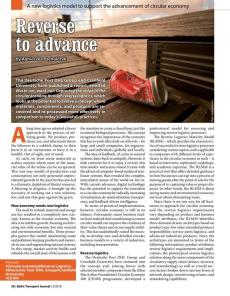
The Deutsche Post DHL Group and Cranfield University have published a report, entitled Waste not, want not: Capturing the value of the circular economy through reverse logistics, which looks at the potential to evolve a concept where materials, components, and products are recovered and re-processed more effectively in comparison to today’ (wasteful) practices.
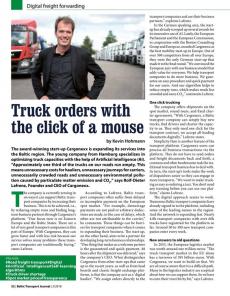
The award-winning start-up Cargonexx is expanding its services into the Baltic region. The young company from Hamburg specializes in optimizing truck capacities with the help of Artificial Intelligence (AI).
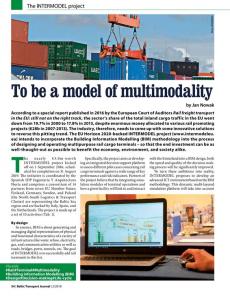
According to a special report published in 2016 by the European Court of Auditors Rail freight transportin the EU: still not on the right track, the sector’s share of the total inland cargo traffic in the EU went down from 19.7% in 2000 to 17.8% in 2013, despite enormous money allocated to various rail promoting projects (€28b in 2007-2013).
The 8th edition of the Transport Week conference took place in Gdańsk on 6-8 March. Topics tackled this year were related to planning and financing of port development projects as well as prospects offered to European logistics by the China-led Belt & Road Initiative (BRI).