

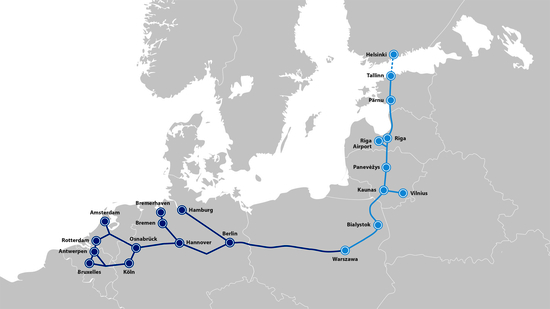
The joint venture RB Rail has launched an open competition for preparing a study on infrastructure management of the standard gauge railway to link the Baltics with the EU.
The aim of this study is to review and analyse a range of cross-border infrastructure management models in order to identify the optimum one for the Rail Baltica project. The study will encompass a set of various factors, including institutional, operational, and economic.
Tender offers can be submitted till August 14th, 2017.
Once completed in 2026, the 870 km long 1,435 mm gauge ERTMS L2 Rail Baltica will crosscut Estonia, Latvia, and Lithuania, joining the Western Europe rail network in Kaunas near the Lithuanian-Polish border. Passenger trains will be able to speed up to 240 km/h, while freight ones (max 740 m long) - up to 120 km/h.
"Given the highly complex stakeholder matrix intrinsic to cross-border infrastructure projects, the study shall aim to achieve a sustainable balance between national considerations, on the one hand, and the Rail Baltica Global Project perspective and its ambition to create an exemplary platform for an efficient functioning of the single European railway market, on the other. All in all, the sooner the infrastructure manager is determined, the sooner we can launch a full-fledged project commercialization strategy - which is a key pre-requisite for the success and long-term sustainability of Rail Baltica," Kaspars Briškens, Business Development Manager, RB Rail, said.
He also added, "In addition, the study shall provide a better assessment of the long-term value of the Rail Baltica infrastructure and, thereby, also of the long-term socio-economic return on the European and national investment. In the case of Rail Baltica, it will also promote greater project transparency and strengthen the case for continued EU support for the project."