

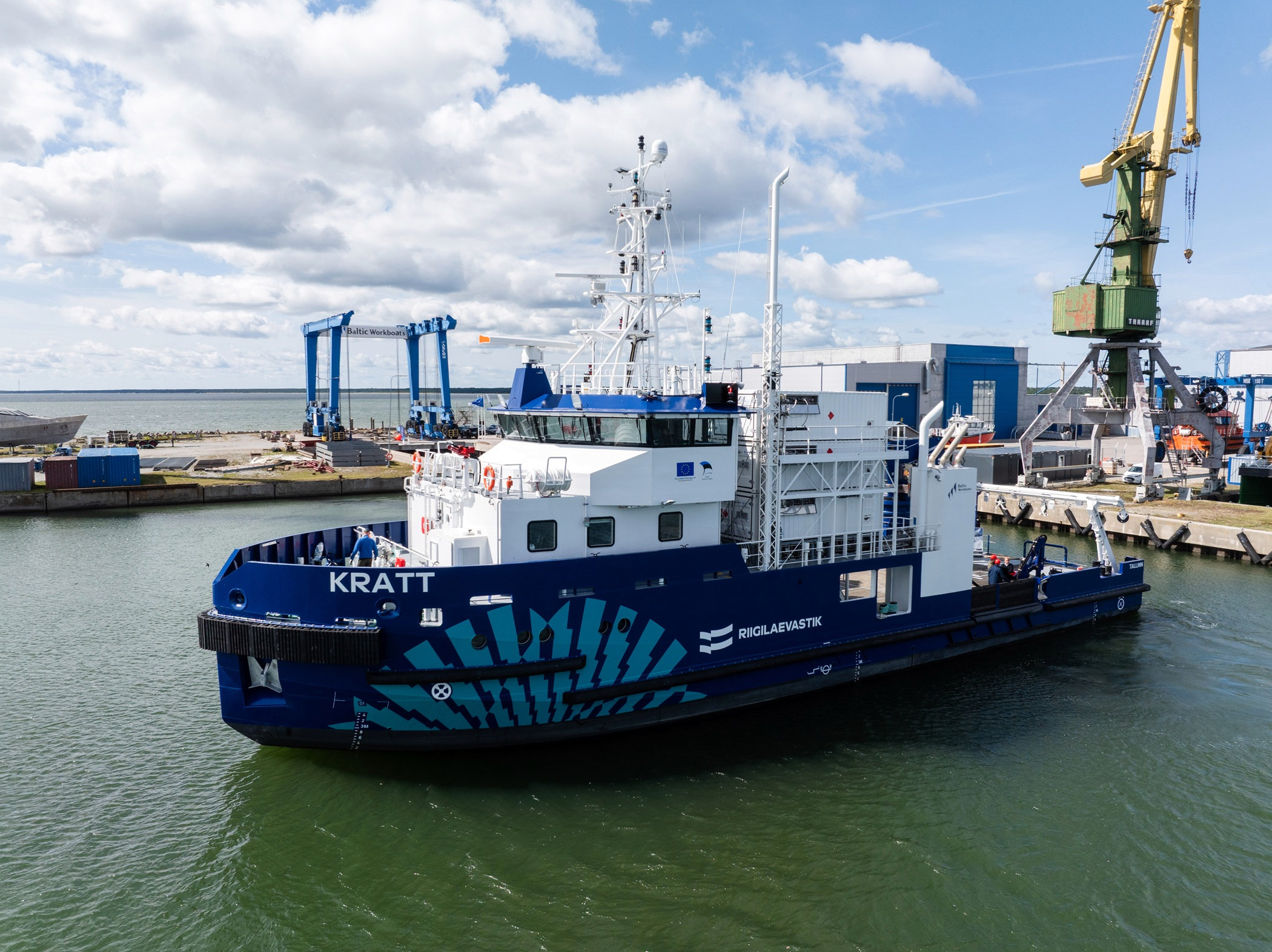
After 30 months of design and construction, KRATT was officially christened on 12 August 2026 in Saaremaaa ahead of her autumn service entry.
The 38-by-10 metres hybrid workboat features four 350kW gas generators, running on biomethane, and a 400kWh battery system. In electric mode, KRATT can operate up to two hours at five knots - or provide electrical power for 10 hours at anchor.
The vessel can operate at sea for up to a week without replenishing supplies, providing accommodation for six crew members and up to 10 researchers (who have at their disposal a 50 m² laboratory). The Ice Class 1C KRATT is also equipped with a 15-tonne lifting capacity crane, mobile and portable pollution containment and recovery gear, and search and rescue support equipment.
"[...] the multipurpose workboat will enter service in Estonian waters this autumn, carrying out a wide range of maritime tasks, from buoy maintenance and fairway services to marine research, pollution response and rescue operations. Its flexible design enables one vessel to perform tasks that would traditionally require several specialised platforms," the Estonian State Fleet, KRATT's operator, detailed in a press briefing.
The organisation's Director General, Andres Laasma, commented, "For a small maritime country, it is important that state vessels are used as efficiently as possible. KRATT is designed as a genuinely multipurpose platform, allowing us to carry out a wide range of essential tasks with one highly capable vessel. Its combination of biomethane propulsion, battery-electric operation, research capabilities, and heavy-duty deck equipment gives us significantly greater flexibility in organising the state's maritime tasks."
Kuldar Leis, Minister of Infrastructure of Estonia, also shared, "KRATT is a milestone for Estonia in moving towards more sustainable shipping and a good example for others to follow. This new vessel shows how a state fleet can become both more capable and more environmentally sustainable at the same time. We need to develop our fleet intelligently - one vessel should be able to perform as many different tasks as possible while doing so with a lower environmental impact. I am particularly pleased that this innovative workboat was designed and built here in Estonia."
With KRATT's hull supplied by Damen's shipbuilders in Gdańsk, the Estonian Workboats was in charge of putting together the €22 million workboat (financed through the EU's NextGenerationEU Recovery Fund). Margus Vanaselja, Chairman of the Management Board of Baltic Workboats, said, "When building this vessel, it was essential to find a solution that combines high work capacity, versatility, and a lower environmental impact. Combining biomethane and electricity offers strong opportunities to achieve this and makes the vessel unique in its solutions on a global scale."
The ship's name refers to a legendary creature in Estonian folklore, portrayed as tireless, industrious, and capable of carrying out a wide range of tasks.
Photo: Robert Markus Liiv