Following the tragic casualty of Maersk Honam, which caught fire on 6 March taking the life of five crew members, and the sad fact that damaging container ship fires are all too frequent, it is timely, particularly for shippers and freight forwarders, to explain the dynamics of as well as risks associated with General Average.
For years, it has been the worst-kept secret for any foreign investor that port concession tender conditions in Ukraine were often drafted to single out one particular winning party.
Last year, our region's seaports for the first time in history handled over 300mt of various general cargo goods, out of which three quarters came in trailers, railcars, and containers.
The predecessor of the 1927-born Swedish Orient Line (SOL), the Svenska Levant Linjen, was established in 1911. As such, SOL witnessed how the maritime world changed throughout the 20th century and continues doing so in the current millennium.
Noting an increase by 4% year-on-year to a total of about 155.4mt, fresh produce accounted for nearly 4% of all dry cargo seaborne trade in 2017. This is good news, right? Well, it depends who we're asking.
Noting an increase by 4% year-on-year to a total of about 155.4mt, fresh produce accounted for nearly 4% of all dry cargo seaborne trade in 2017. This is good news, right? Well, it depends who we're asking.
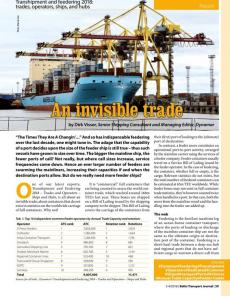
"The Times They Are A Changin'…" And so has indispensable feedering over the last decade, one might tune in. The adage that the capability of a port decides upon the size of the feeder ship is still true - thus such vessels have grown in size over time. The bigger the mainline ship, the fewer ports of call?
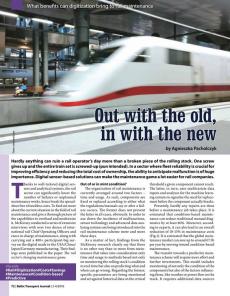
Hardly anything can ruin a rail operator's day more than a broken piece of the rolling stock. One screw gives up and the entire train set is screwed-up (pun intended). In a sector where fleet reliability is crucial for improving efficiency and reducing the total cost of ownership, the ability to anticipate malfunction is of huge importance.
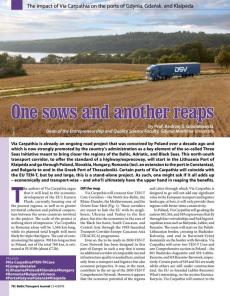
Via Carpathia is already an ongoing road project that was conceived by Poland over a decade ago and which is now strongly promoted by the country's administration as a key element of the so-called Three Seas Initiative meant to bring closer the regions of the Baltic, Adriatic, and Black Seas.
Digitisation is on everyone's lips these days and the logistics sector is no exemption from this rule. While it may appear that there's a wide variety of IT solutions on the market for the industry to sufficiently tackle the challenge of bringing one's business onto the next digital level, this is in itself, paradoxically, also a major obstacle to the digitisation of the supply chain. What is namely missing is a united and feasible approach.