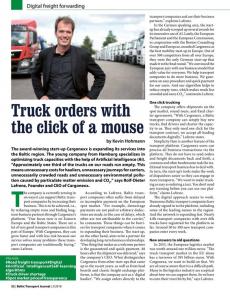
The award-winning start-up Cargonexx is expanding its services into the Baltic region. The young company from Hamburg specializes in optimizing truck capacities with the help of Artificial Intelligence (AI).
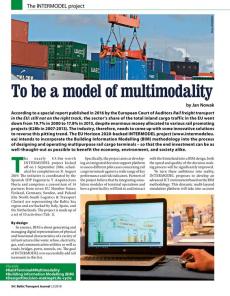
According to a special report published in 2016 by the European Court of Auditors Rail freight transportin the EU: still not on the right track, the sector’s share of the total inland cargo traffic in the EU went down from 19.7% in 2000 to 17.8% in 2013, despite enormous money allocated to various rail promoting projects (€28b in 2007-2013).
The 8th edition of the Transport Week conference took place in Gdańsk on 6-8 March. Topics tackled this year were related to planning and financing of port development projects as well as prospects offered to European logistics by the China-led Belt & Road Initiative (BRI).
GoLNG - a project within the Interreg Baltic Sea Region Programme that’s focused on the development of demand and accessibility of liquefied natural gas (LNG) in line with the EU Clean Fuel Strategy and the EU Directive on Deployment of Alternative Fuel Infrastructure - recently held a conference and a study tour.
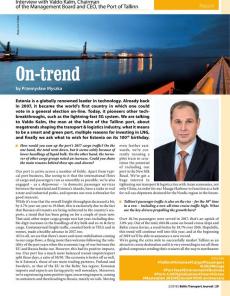
Estonia is a globally renowned leader in technology. Already back in 2007, it became the world’s first country in which one could vote in a general election on-line. Today, it pioneers other techbreakthroughs, such as the lightning-fast 5G system.
In an already slow to adapt industry, a port agency is perhaps one of the most reluctant adopters in the maritime space of technological innovation. While spreadsheets and e-mails are commonplace, equally, so are handwritten workbooks and post-it notes.
Ports are often viewed as the barometer of the economy and of industrial demand and output. Signs of the economic turning points, the theory goes, can be sensed through the ports’ pulse, sometimes long before official statistics reveal that something must be going up.