GoLNG - a project within the Interreg Baltic Sea Region Programme that’s focused on the development of demand and accessibility of liquefied natural gas (LNG) in line with the EU Clean Fuel Strategy and the EU Directive on Deployment of Alternative Fuel Infrastructure - recently held a conference and a study tour.
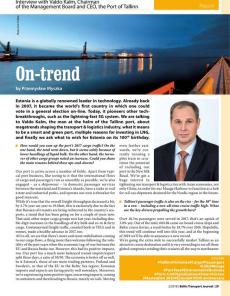
Estonia is a globally renowned leader in technology. Already back in 2007, it became the world’s first country in which one could vote in a general election on-line. Today, it pioneers other techbreakthroughs, such as the lightning-fast 5G system.
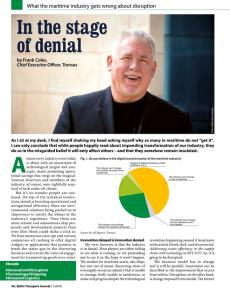
In an already slow to adapt industry, a port agency is perhaps one of the most reluctant adopters in the maritime space of technological innovation. While spreadsheets and e-mails are commonplace, equally, so are handwritten workbooks and post-it notes.
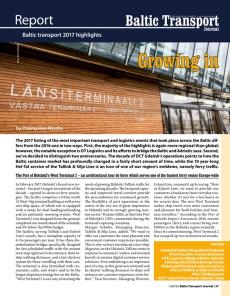
Ports are often viewed as the barometer of the economy and of industrial demand and output. Signs of the economic turning points, the theory goes, can be sensed through the ports’ pulse, sometimes long before official statistics reveal that something must be going up.
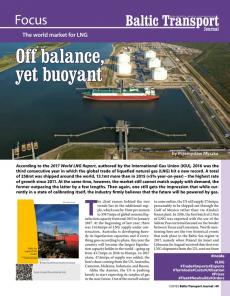
According to the 2017 World LNG Report, authored by the International Gas Union, 2016 was the third consecutive year in which the global trade of liquefied natural gas hit a new record.
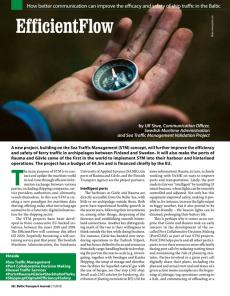
A new project, building on the Sea Traffic Management concept, will further improve the efficiency and safety of ferry traffic in archipelagos between Finland and Sweden.